
Architecting the MCA Fantasy League — Real-Time Cricket Fantasy at 540K+ Users
How I built the official Mumbai Cricket Association fantasy platform from zero — system topology, live scoring pipeline, the Impact Player mechanic, rotating-JWT auth, DPDP-ready PII at rest, and the production incident that taught me the most.
In June 2026 the Mumbai Cricket Association launched its first official fantasy cricket platform on top of the T20 Mumbai League — the state-level T20 tournament played at Wankhede Stadium. I led the architecture and delivery end-to-end: three frontends, one backend, real-time scoring from live iSportz feeds, and a production launch that survived the chaos a live sports product always brings.
This post is the architecture writeup I wish I'd had access to before I started. Stack choices, trade-offs, the mechanics I had to invent, and the one production incident that taught me more than any pre-launch design review.
The brief
MCA already had a fan-engagement platform — t20mumbai.com — running fan
polls and a "Viewers' Choice" feature. What it didn't have was fantasy.
Two months out from the tournament, the ask landed: ship an official
fantasy product for the T20 Mumbai League — multi-platform, real-time
scored, admin-controlled, and able to live next to the existing fan
platform without disrupting it.
Constraints worth calling out upfront, because they shaped every subsequent choice:
- Real cricket data. The iSportz CDN provides the official live feeds for the tournament. There's no second source of truth — if iSportz misbehaves, the system must absorb it gracefully.
- Three product surfaces. A consumer web app, a native mobile app (Capacitor wrapper around the same web), and an admin console — all on a single backend.
- A real launch date. First ball of the first match was non-negotiable.
- Existing users. The 540K+ user base on the fan platform had to remain intact and authenticated across the new product.
System topology
Before drawing a single box on a diagram, I locked the topology: one backend, three frontends, two stateful stores, two external vendors.
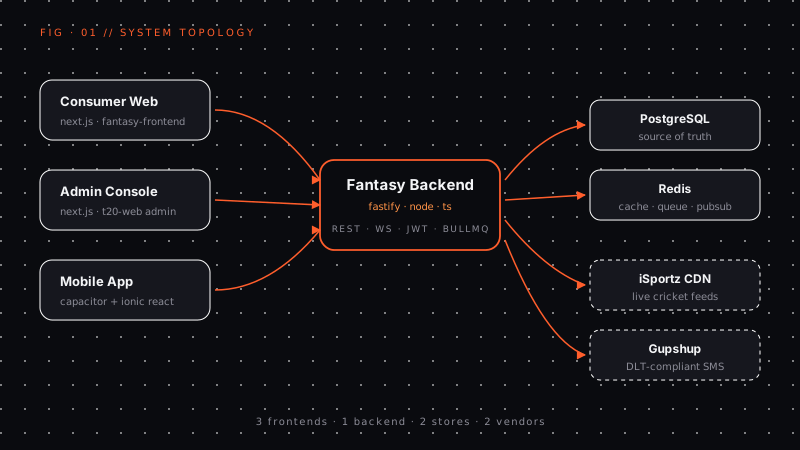
The mobile app is a Capacitor shell wrapping a webview of the fantasy
frontend. That choice was deliberate: shipping native iOS and Android
in parallel with a web app, on a two-month clock, would have meant cutting
something. With Capacitor, the same React code ships everywhere; the
mobile layer adds bearer-token auth (instead of the web's httpOnly
refresh cookies) and a small X-Client header for backend routing
decisions.
The data foundation — and the resolver pattern that makes it work
The fantasy domain has three layers of identity:
- Vendor IDs — what iSportz's feed uses (
PlayerID,MatchID). - Canonical IDs — internal
fantasy_match_player.player_id(fmp.player_id). - Display IDs — what users see (jersey name, role badge, credits).
Without a disciplined bridge between vendor and canonical, you end up silently dropping points because "PlayerID 5234 in card data" doesn't match "5234A in squad data" because iSportz changed how they suffix Impact Player rows mid-tournament.
The bridge is a single column: feed_player_unique_id. Every
fantasy_match_player row carries it; every score lookup goes through a
resolver that maps vendor PlayerID → fmp.player_id by way of
feed_player_unique_id. When that column was missing or stale, a
Layer-A name auto-learner stepped in: fuzzy-match the player name to
the squad, stamp the result back, and never look up by name again.
// Simplified — real implementation includes IP/RP suffix stripping,
// substring fallbacks, and per-match learning to avoid cross-match
// pollution.
async function resolveCanonicalId(
  matchId: string,
  vendorPlayerId: string,
  playerName: string,
): Promise<string | null> {
  // Fast path: stamped feed_player_unique_id.
  const stamped = await db.queryOne(
    `SELECT player_id FROM fantasy_match_player
     WHERE match_id = $1 AND feed_player_unique_id = $2`,
    [matchId, vendorPlayerId],
  );
  if (stamped) return stamped.player_id;

  // Layer A — name auto-learner. Match by name, stamp on hit so
  // future lookups skip this branch.
  const byName = await db.queryOne(
    `SELECT player_id FROM fantasy_match_player
     WHERE match_id = $1 AND normalize(player_name) = normalize($2)`,
    [matchId, playerName],
  );
  if (byName) {
    await db.query(
      `UPDATE fantasy_match_player SET feed_player_unique_id = $1
       WHERE match_id = $2 AND player_id = $3`,
      [vendorPlayerId, matchId, byName.player_id],
    );
    return byName.player_id;
  }
  return null;
}
This single pattern — vendor → canonical via a stamped bridge, with a learner as fallback — is the most important architectural call I made on this project. Every downstream system (scoring, Impact Player, admin panel) trusts the canonical ID and stays decoupled from feed quirks.
Live scoring pipeline
Fantasy scoring is "easy" in the abstract (player did X → award Y points) and brutal in practice. The hard parts are:
- Feeds arrive partial and out of order.
- The same event can appear in multiple feed payloads (the latest innings file vs. yesterday's matchsummary).
- Users want to see deltas instantly when their team moves.
- Anything that fails has to be retryable without double-counting.
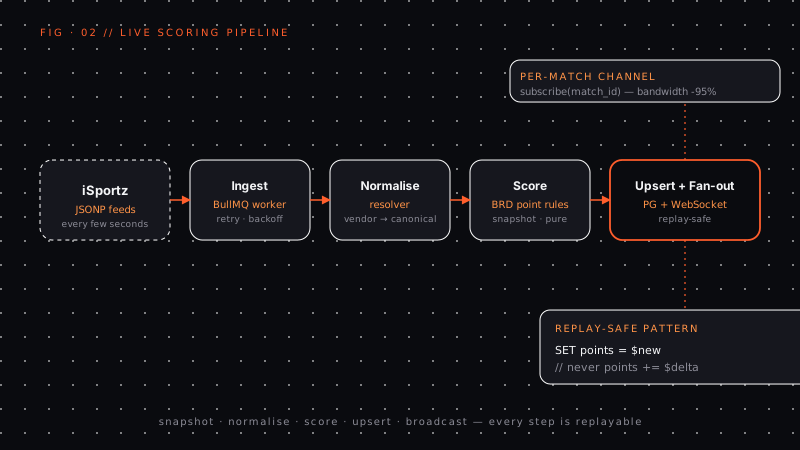
The pipeline:
- Ingest worker polls iSportz JSONP feeds every few seconds.
- Normaliser strips JSONP wrappers, resolves canonical IDs, and
produces a flat list of
(player, event, value)triples. - Scorer applies the BRD point rules — runs, wickets, catches, strike rate bonuses, economy bonuses, the +4 Impact Player activation bonus, captain (2×) and vice-captain (1.5×) multipliers — and computes the per-player point total for this snapshot.
- Upsert the per-player points into
entry_player_pointsusing a single multi-rowINSERT … ON CONFLICT DO UPDATE. The DB is the reduce step. - Fan out the affected
entry_ids over WebSocket so any user currently watching their team sees points tick live.
The "scorer produces a snapshot, DB stores the snapshot" pattern is what
makes it replay-safe. There's no "add 4 more points" logic anywhere —
every score row is SET points = $new, not points += $delta. Re-run
the same feed twice and you get the same totals.
The Impact Player mechanic
T20 Mumbai uses the Impact Player rule: each team carries one "designated reserve" alongside the playing XI, and can swap that reserve in mid-match for a strategic boost. In fantasy, this becomes a high-stakes pick — the user effectively bets on whether the reserve will be activated.
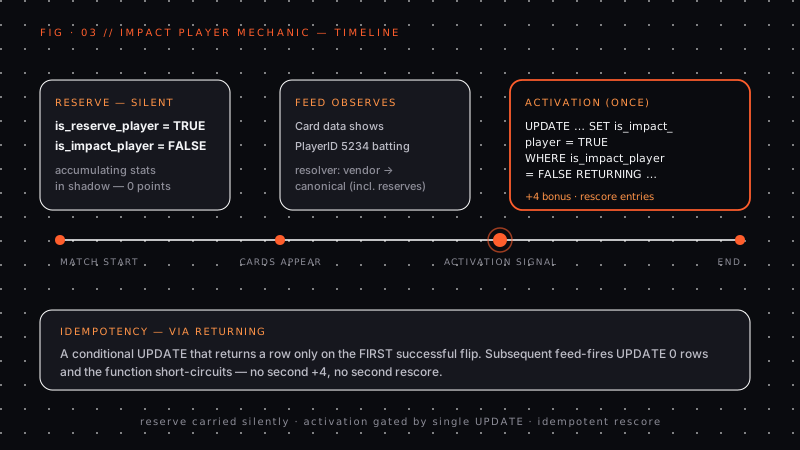
Mechanically:
- Every
fantasy_match_playercarries anis_reserve_playerflag and anis_impact_playerflag. - A reserve scores no points by default — they're "silent" in the squad.
- When iSportz's feed surfaces the reserve as actively performing (their
PlayerIDshows up in card data, or the dedicated(IP)/(RP)suffix flips on a card), the scorer treats it as activation:- Set
is_impact_player = true, stampimpact_activated_at. - Award +4 activation bonus.
- Rescore all entries that picked this reserve — back-crediting any points their activity already generated before activation was detected.
- Set
The whole thing has to be idempotent. If the feed dropped the activation signal once and re-fired it five minutes later, the second fire must not award a second +4 or duplicate the rescore. The pattern:
// Activation is gated by a single conditional UPDATE. Only the FIRST
// successful UPDATE returns a row; subsequent calls UPDATE 0 rows and
// the function short-circuits without awarding bonus or rescoring.
const activated = await db.queryOne(
  `UPDATE fantasy_match_player
     SET is_impact_player    = TRUE,
         impact_activated_at = now()
   WHERE match_id              = $1
     AND feed_player_unique_id = $2
     AND is_reserve_player     = TRUE
     AND is_impact_player      = FALSE
   RETURNING player_id`,
  [matchId, vendorPlayerId],
);
if (!activated) return; // already activated — short-circuit
await awardActivationBonus(activated.player_id, matchId);
await rescoreEntriesPicking(activated.player_id, matchId);
RETURNING player_id from the conditional UPDATE turns "is this the
first activation?" from a question into a fact. No race, no double-fire.
Auth — rotating JWT with a multi-tab grace window
For 540K users across web and mobile, the auth needs to be stateless enough to scale and stateful enough to support revocation. The shape I landed on:
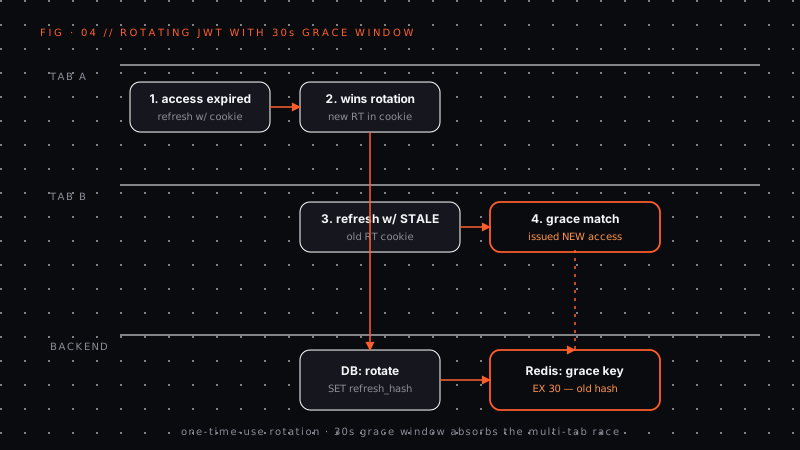
The pieces:
- Access token — short-lived JWT, signed with HS256. Carries
sid(session ID) so revocation lookups don't need the full token. - Refresh token — opaque 32-byte hex, hashed at rest in
fantasy_session.refresh_token_hash. Raw token only ever lives in the user's cookie / bearer header. - One-time-use rotation — every refresh issues a new refresh token and invalidates the old one's hash.
- 30-second grace window — the prior rotation's hash is parked in Redis with a 30s TTL. Two tabs racing the same refresh both succeed: one wins the DB rotation; the other lands inside the grace window and still gets a valid access token.
The grace window is the kind of detail that sounds optional until you've shipped without it and watched users get silently logged out because two tabs refreshed simultaneously. The fix is small; the UX impact is huge.
The team-composition validator
The fantasy XI is constrained: 11 players, role bounds per BRD, max 1
Icon, max 7 from a single franchise, ≤100 credits, captain + vice-captain,
optional U-19 booster pick. The bounds shifted mid-tournament — the
BRD originally said 4-6 BAT / 2-3 AR / 3-4 BOWL and was widened to
3-5 / 3-5 / 2-4 to give users more team-building freedom.
That mid-tournament widening exposed a latent bug in the validator that taught me a useful lesson about implicit invariants:
// OLD code:
if (counts.BAT  < 4)  throw httpError(400, "need_at_least_4_bat");
if (counts.AR   < 2)  throw httpError(400, "need_at_least_2_ar");
if (counts.BOWL < 3)  throw httpError(400, "need_at_least_3_bowl");
// "Upper bounds are implicit from the length-11 schema."
The comment was right — under the OLD bounds. With 4+2+3 = 9 mandatory
slots and a total of 11, you literally cannot construct an invalid XI
that satisfies the lower bounds. The two flex slots can't push BAT past
6 without pushing AR or BOWL below their minimums.
Widening the lower bounds to 3+3+2 = 8 gave users three flex slots.
Now 6 BAT + 3 AR + 2 BOWL = 11 satisfies every lower bound and violates
the BAT cap of 5. The "implicit upper bound" trick collapsed:
// NEW code:
if (counts.BAT  < 3)  throw httpError(400, "need_at_least_3_bat");
if (counts.AR   < 3)  throw httpError(400, "need_at_least_3_ar");
if (counts.BOWL < 2)  throw httpError(400, "need_at_least_2_bowl");
if (counts.BAT  > 5)  throw httpError(400, "too_many_bat");
if (counts.AR   > 5)  throw httpError(400, "too_many_ar");
if (counts.BOWL > 4)  throw httpError(400, "too_many_bowl");
Lesson: when an invariant "is implied" by something else, document the chain of reasoning. The next person changing the inputs needs to know which assumptions to re-verify.
DPDP-readiness: PII at rest
India's DPDP Act puts real teeth into how user PII is stored. For mobile-number and email, "encrypted at rest, displayable to admins" sounds contradictory the first time you hear it — hashing is one-way, encryption is two-way. The pattern that resolves the contradiction:
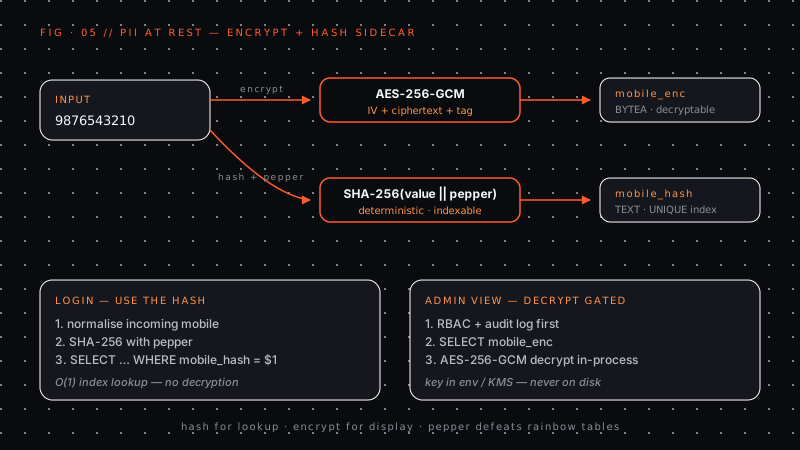
For each PII column you store two values:
| Column | Type | Purpose |
|---|---|---|
mobile_enc | BYTEA | AES-256-GCM ciphertext. Decrypt when an authorized context needs the plaintext. |
mobile_hash | TEXT | SHA-256 of normalized mobile + a server-side pepper. Indexed. Used for OTP lookup, dedupe, signup uniqueness. |
The hash makes login fast — lookup by mobile_hash is a single indexed
query. The pepper turns the hash into a useful protection: phone numbers
have only ~10¹⁰ possible values, so without a pepper an attacker who
steals the DB can build a rainbow table in minutes. With a server-side
pepper that lives outside the DB, the rainbow table needs the pepper
too — and if they have your app secrets, the DB exfiltration was the
least of your problems.
The S4-M12 incident — and what it taught me
Two weeks into the season, S4-M12 (Sarfaraz Ahmed Naushad Ahmed Khan as designated reserve) didn't credit Impact Player points to users. The symptom was visible to users: their team showed lower-than-expected scores. The cause was buried.
The investigation went through three layers of "obvious" before landing at the real cause:
- First guess — scoring bug. Re-ran the scorer against the feed payload. Same incorrect output.
- Second guess — feed corruption. Diffed iSportz payloads against prior matches. Feed was clean.
- Real cause — the resolver was filtering out reserves before they could be activated.
The resolver had a clause that I'd added "defensively" months earlier:
WHERE feed_player_unique_id = $1
  AND is_playing_xi IS DISTINCT FROM FALSE
The intent was: don't resolve players who haven't been announced for
this match. The unintended consequence: designated reserves have
is_playing_xi = false by definition (they're not in the announced
XI), so the resolver returned null. With no canonical ID, the
activation UPDATE matched 0 rows. With no activation, no rescore.
With no rescore, no points to the user.
The fix was one line:
WHERE feed_player_unique_id = $1
  AND (is_playing_xi IS DISTINCT FROM FALSE OR is_reserve_player = TRUE)
The actual lesson wasn't about the SQL. It was about defensive code
that nobody documents the reason for. The original is_playing_xi
guard was protecting against a real scenario — leftover non-XI rows
from a prior match's squad polluting the lookup. I'd written the guard,
shipped it, never linked it to the scenario it was protecting against
in a comment, and months later didn't remember why it was there.
The post-incident commit message reads:
fix(scoring): include designated reserves in canonical resolver

Resolver was filtering is_playing_xi=FALSE rows out, which meant
reserves (definitionally not in the announced XI) never resolved.
With no canonical ID, activation UPDATE matched 0 rows -> reserve
was never marked impact_activated -> users lost points.

The is_playing_xi guard was added in PR #143 to prevent leftover
squad rows from a prior match polluting lookups. That problem is now
solved by per-match indexing, so the guard is redundant. Replaced
with the simpler "in this match's squad" predicate, with an explicit
OR for reserves to be future-proof against re-introducing the guard.

Mitigation in production: manually marked the reserve activated via
admin panel + force-rescored. All affected entries credited.
Production incidents are the only feedback loop that exposes which of your invariants weren't really invariants. This one cost an evening; it permanently raised my bar for documenting why a piece of defensive code exists.
“
Defensive code without a documented reason becomes the next outage's hiding place.
”
What I'd do differently
Two honest retros:
-
Stand up the DLT-compliant SMS pipeline on day one. I deferred it because notifications felt low priority next to scoring. DLT template approval takes 1-3 business days end-to-end, and you can't start that clock until you have the exact template body locked. When MCA later wanted "send all users an SMS when XI is announced," the code was a one-day build but the approvals were a one-week wait. The ROI on starting the approval flow on day one is just enormous — the code change is small.
-
Build the rescore-by-admin tool on day one. I shipped Force Rescore as an admin endpoint after the S4-M12 incident. It would have saved 90 minutes that night, and three or four more incidents since. Build the "manual override of the automated system" as a first-class feature, not an emergency add.
Stack & numbers
Backend: Fastify · Node.js · TypeScript · PostgreSQL · Redis · BullMQ · WebSockets · Zod schemas · iSportz CDN integration · Gupshup SMS (DLT-compliant)
Frontend: Next.js 16 · React 19 · TailwindCSS · framer-motion (consumer web + admin)
Mobile: Capacitor + Ionic React (one codebase, web + iOS + Android)
Auth & security: JWT (HS256) · rotating refresh tokens with grace window · Redis-backed revocation cache · AES-256-GCM PII at rest with hash sidecar lookups (DPDP-ready)
Ops: Idempotent admin operations · audit log on every privileged mutation · masked-PII logging · per-match WebSocket channels
If you're building real-time scoring on top of a sports feed, or weighing the trade-offs around stateless JWT with revocation, or just trying to make sense of how India's DLT and DPDP rules shape backend design — feel free to reach out. I'm always up for a conversation about production systems built under real constraints.